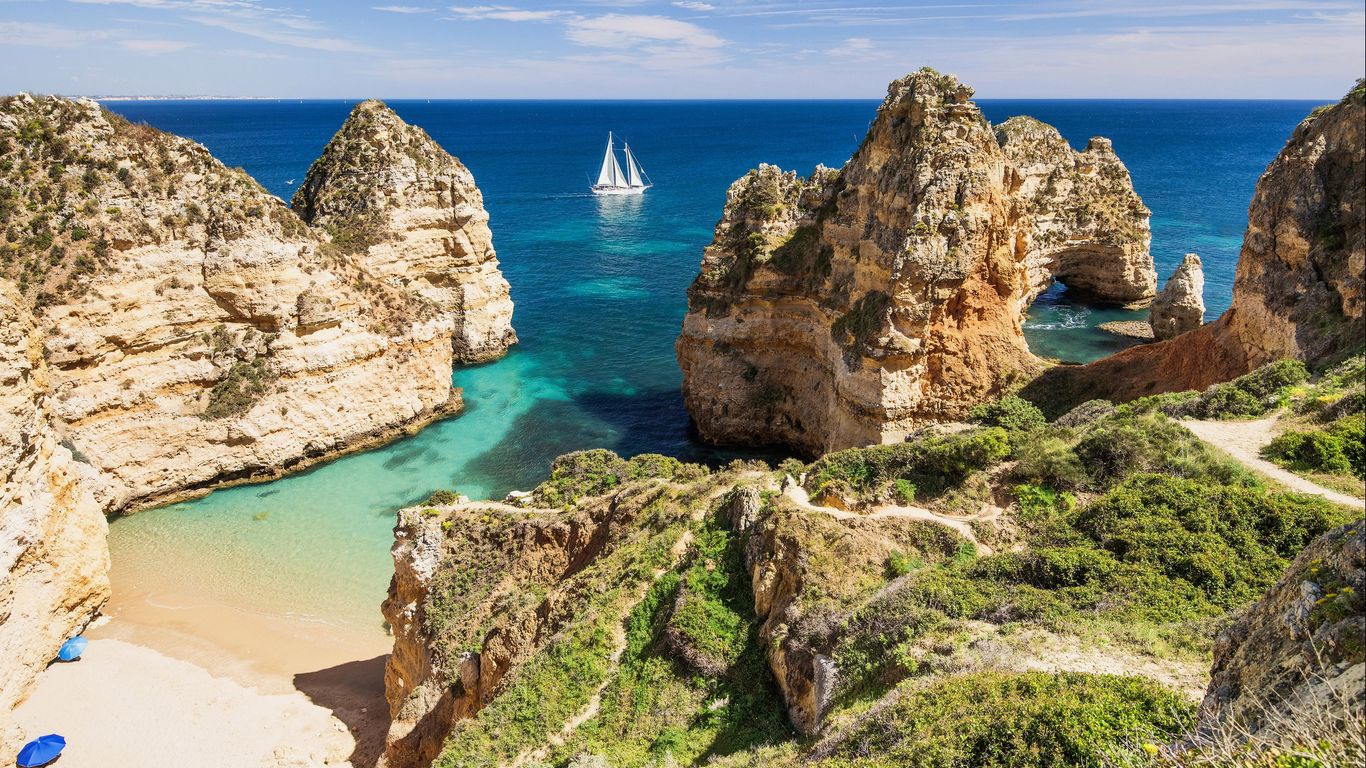
The southwest corner of the Algarve is where Portugal runs out of land, and the road there is the reason to come. Start in Lagos, where the old town sits behind its walls and the marina fills with day boats. From the clifftop at Ponta da Piedade the coast unfolds in ochre stacks and sea caves, best seen from a small boat that noses in under the arches at half tide.
West of Lagos the N125 hands you off to smaller coast lanes. A Fiat 500 Cabrio stops being a novelty here and becomes the whole point. Drop the roof at Luz and leave it down. The cliffs run in reds and golds, the Atlantic opens on your right, and every few kilometres a hand-painted sign points down a dirt track to a praia you have never heard of. Take one.
The coves are the reward for pulling over. Praia do Camilo hides at the foot of two hundred wooden steps; Praia da Marinha shows up on every Algarve poster and still earns it; smaller strands sit unnamed between the two. Go early — by noon the car parks fill and the light goes flat and white. Mid-morning and late afternoon are when the cliffs actually glow.
Sagres feels like the end of something, and it nearly is. The fortress sits on a wind-scoured headland where sixteenth-century navigators are said to have planned their voyages, and the wind here never fully drops. A few kilometres on, Cabo de São Vicente is the actual southwest tip of Europe — a red lighthouse on a cliff, the sea on three sides, and a queue of camper vans waiting for the sun to fall into the ocean.
Time your run so the roof is still down at the cape for sunset. There is nowhere further to drive; the road simply stops at the lighthouse gate and the continent ends. Then turn the little car around, put the heater on for the cool ride back, and let the headlights find the N268 home through the dark cork hills.