The drive into Évora is half the experience. From Lisbon the A6 peels off across the Alentejo, and the country opens into something close to empty — wheat plains rolling to the horizon, cork oaks standing alone in the stubble, and roads that run dead straight for kilometres under an enormous sky. This is the least crowded corner of Portugal, and after the coast the quiet lands on you like a change in pressure.
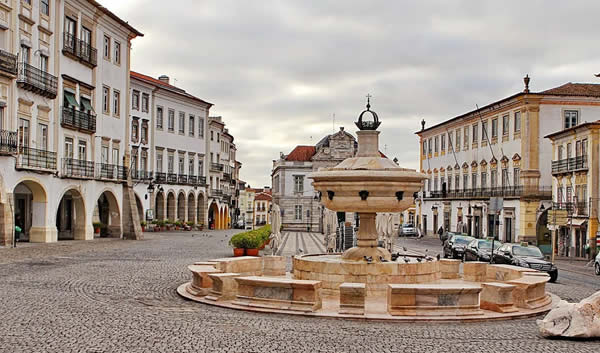
Évora itself is a walled town that has been lived in continuously since the Romans, and it wears every layer at once. In the centre, the so-called Temple of Diana stands in the open — fourteen granite columns with marble capitals, the best-preserved Roman temple on the Iberian peninsula, floodlit at night and casually surrounded by cafés. You can walk right up to it, which is somehow more startling than any barrier would be.
A short walk away, the Capela dos Ossos delivers the town's darker souvenir. This small chapel is lined floor to ceiling with the bones of some five thousand monks, arranged in careful patterns, with an inscription over the door that reminds you the dead are waiting for the living. It is not morbid so much as matter-of-fact, a medieval memento mori that the Alentejo, with its long silences, seems oddly suited to hold.
Drive out of town for the megaliths, because the Alentejo was sacred ground long before Rome. The Almendres Cromlech stands in a cork grove about fifteen kilometres west, a ring of nearly a hundred standing stones raised some seven thousand years ago — older than Stonehenge, and usually yours alone. The last stretch is dirt road; take it slowly and the stones appear between the trees, warm and rounded in the low sun.
Then there is the wine. The Alentejo makes big, sun-filled reds, and half the estates around Évora open for tastings and long lunches under the oaks. Pick one within a short drive, eat the bread and the black pork, and let someone else pour. The roads home run straight and empty into the dusk, with the whole plain going gold and then blue around you.